Friday, January 19, 2007

Guru Mani Ratnam

What a joy to catch the new Mani Ratnam film in the cinema, only tempered by the thought that this film -- from India's premier director -- didn't get reviewed in the UK press. Partly this was because the distributor probably didn't offer a press screening, but even so, you would expect the reviewers of the broadsheets to look out for Mani's films.

It was enjoyable and it's an important film in terms of the story and the performances from Abhishek Bachchan and Aishwaria Rai, but I have to admit that as a Mani Ratnam film it's slightly disappointing lacking some of the sheer bravura of earlier films. I also thought the songs were less memorable. I've looked at several Indian reviews of the film and I'm with the bulk of them. Mani Ratnam often suffers from being too commercial for the cinephiles and too serious for the popular audience (some of yesterday afternoon's tiny audience left before the end). But this could be construed as demonstrating that it is the audience and the industry who need to catch up. I think that Mani may indeed be the Indian director who makes the film that finally breaks Hindi Cinema in American multiplexes (which would be ironic for a Tamil director).

The importance of the story lies in its approach to the history of Indian capitalism. It draws on the career of
Dhirubhai Ambani, founder of Reliance Industries, and offers a picture of how business was conducted before the relatively recent 'liberalisation' of the Indian economy. There is a a discourse of social class running through the film with the central character Gurubhai Desai appealing as a 'villager from Gujerat' for the support of ordinary shareholders rather than the upper middle-class who previously controlled Indian business. My companion at the screening, who has worked in the international petrochemical business, commented that he didn't think such a story could have been told in India until the last few years. Whilst the film works well to expose the corruption and bribery that went on, it also works well as a melodrama of surrogate fathers and sons. There are, however, several plot holes in the melodrama and some characters seem to simply disappear.

There is a detailed entry on the film at Wikipedia and early signs are that it has done very well in India and in North America and Australia. In the UK it ranked 15th on a 44 screen opening with a screen average of over $7,000 (Screen International).

It would be good if someone released Mani Ratnam's earlier work on DVD in the UK. (I was intrigued to see that Time Magazine included Nayakan (1987) on a list of 'all-time' Top 100 films.

Wednesday, January 17, 2007

Awards season

The Golden Globes, the run-up to the Oscars – an interesting exercise in how the industry ('the business' according to yesterday's Guardian) is feeling about itself, the whole process is still annoying in terms of what gets recognised and what doesn't.

People I meet on courses or at events often ask me what I think about this or that film and they seem surprised that I haven't seen such an important film. I'm not sure if this is true for everyone who teaches film, but I certainly don't get to the cinema as often as I would like (lack of organisation, probably) and when I do get to a screening, it's often a film I've booked or I'm considering booking for a course. Although I do often see films for work, I do enjoy seeing films just for fun, but then I choose very carefully. The more hype a film receives, the less I am likely to see it, unless something specific in the promotion (or word of mouth) attracts me. In 2006 I saw just over a film a week at the cinema. Here is the list of titles, leaving out multiple screeenings of the films I used on events:

The Departed, Red Road, Children of Men, Pan's Labyrinth, The Host (S. Korea), Shanghai Dreams (China), Ghost World, A History of Violence, Princess Mononoke, Zidane: A 21st Century Portrait, Man Push Cart, The History Boys, American Psycho, Love + Hate, Tsotsi, Three Times (Taiwan), Tickets, The Wind That Shakes the Barley, The Last Picture Show, Brokeback Mountain, Hi-Lo Country, Volver, Innocent Voices, Kiss Me Deadly, The River (Renoir), The Bad Sleep Well (Kurosawa), Twilight Samurai, An Actor's Revenge (Japan), 36, Down in the Valley, Inside Man, Untold Scandal (S. Korea), Taxi Driver, Confetti, Life is to Whistle (Cuba), The Waiting List (Cuba), Omkara (India), Miami Vice, Pirates of the Caribbean 2, Superman Returns, Marie Antoinette, Shaun of the Dead, La Haine, Sweet Sixteen, Crash, The Three Burials of Melquiades Estrada, Hidden, The Beat That My Heart Skipped, Intimacy, Memories of Murder (S. Korea), My Sassy Girl (South Korea) Nowhere to Hide (S. Korea), Le Doulos, Les Armees des Ombres, Paisa, Dirty Pretty Things, Edward Scissorhands, The Notorious Bettie Page, Walk the Line, A Cock & Bull Story

Out of these, there was only one that wasn't worth the bother – Confetti. From the rest, I can select some possible award winners from this year's releases:

Best debut picture: Red Road for its intensity and roller coaster last third and The Three Burials of Melquiades Estrada for being the best Peckinpah-style movie since Sam went (would be good if the same director and writer tackled Cormac McCarthy's border stories)

Best re-release: Les Armees des Ombres (see my earlier blog entry)

Most enjoyable: Volver

Most adventurous direction: Children of Men – lots of holes in the story, but a brave and technically skilful rendition of the UK in 20 years time with good performances.

Most unjustly ignored in the UK: The Host – the best action film I've seen, a mammoth blockbuster in East Asia, its shunning by UK audiences is shaming.

Most over-rated film: Hidden – supposedly the favourite film for discussion around the dinner tables of North London. Certainly a well-made film with good performances and a couple of stunning moments, but I sense an emptiness where it purports to be saying something profound.

Best picture: Pan's Labyrinth. A wholly deserved triumph for Guillermo del Toro – perhaps someone will now re-release The Devil's Backbone on 35mm, since it disappeared soon after its first outing.

2007 has started well and A Prairie Home Companion was hugely enjoyable and a fitting send-off for Robert Altman.


Wednesday, January 03, 2007

Something worth watching on television?


I've almost given up on mainstream television. Apart from Match of the Day there isn't much that I'll try hard to watch. The last show that I really looked forward to was Victoria Wood's adaptation of Nella Last's wartime diaries (which didn't disappoint). I did enjoy Helen Mirren in Prime Suspect and I'm looking forward to the second series of Life on Mars, but I'm most interested in the start of Ugly Betty on Channel 4 on Friday.

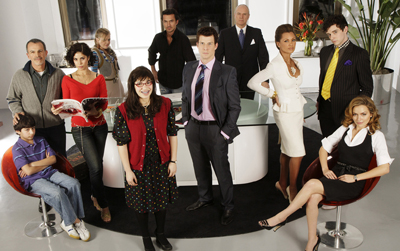
Ugly Betty has been one of the few new shows to make an impact on ABC in the US in Autumn 2006. It's the first American attempt to create a telenovela. The telenovela is a uniquely Latin American televisual form that has successfully sold around the world (except, so far, in the UK). I've not watched one beyond a few minutes, but I've been aware of their fascination for audiences in countries I've visited. Pitched midway between a serial (i.e. a literary adaptation spread over several episodes) and a continuous serial (i.e. a soap), telenovelas typically run for a couple of years but then the narrative reaches a conclusion. Ugly Betty is based on a Columbian telenovela, Yo soy Betty, la fea, which ran from 1999-2001 with 169 episodes. Fantastically popular in Latin America, the show was remade in Mexico and then by Disney (Touchstone). The US version is listed as 60 mins per episode (less the ad breaks), but IMDB lists both 30 mins and 45 mins for the running time in Mexico. It's a Cinderella story about the 'plain' girl who goes to work for a fashion magazine. Channel 4 is advertising it as a comedy, but I suspect it is much more. It has (in the UK) been discussed in terms of the recent hit film The Devil Wears Prada, but of course its story predates the film.

Betty is played by America Ferrera, who began her career as the lead in Real Women Have Curves, an HBO film that won awards at Sundance in 2002 and launched America's career as one of the new young Latina stars in the US. I've enjoyed using Real Women with students and that's partly why I'm looking forward to the telenovela. The Mexican star Salma Hayek, who has been used (and misused?) by Hollywood appears in the first few episodes of Ugly Betty (at first as an actor in the telenovela that the Suarez family watches at home) and as an executive producer she was instrumental in the casting of America Ferrera (see the abc website for a video chatshow segment of Hayek and Ferrera). There seem to be other Hispanic-Americans also involved in the show and I'm intrigued to see how far Hollywood will go in embracing Hispanic culture for mainstream television. Hayek makes the point about the melodrama of the telenovelas -- can't wait.

I hope the show is a hit in the UK and draws a different demographic mix to Channel 4. The Wikipedia entries on the show are very detailed and useful for any classroom work.

Thursday, December 14, 2006

The Departed


Finally managed to catch The Departed before it disappeared from the big screen. I'm not sure what I think of it. Having seen and enjoyed Infernal Affairs in the cinema, there was nothing quite as startling in Scorsese's film.

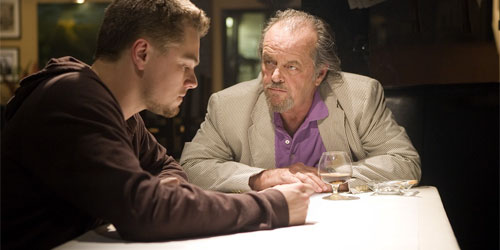
Having read several reviews, I think I'm with J. Hoberman in Village Voice. The Departed is much longer than Infernal Affairs but it doesn't do a great deal more. It is, of course, extremely well-made and very enjoyable as a genre film, but tight and lean it isn't. It also lacks , for me, real interest in characters. I was prompted to think of a movie I love a great deal -- Donnie Brasco (1997) in which Johnny Depp plays the undercover cop and Al Pacino the low grade mafioso who becomes his surrogate father. By packing The Departed with the likes of Jack Nicholson and Martin Sheen, Scorsese seems to be going for depth in the playing, but Nicholson can't for me achieve the force of Pacino and Depp is leagues ahead of Matt Damon, DiCaprio (one of his better performances) and Mark Wahlberg (an odd and well received performance). I worry that it is my own old man's view and also possibly my arthouse snobbery, but no-one in The Departed gets within ten miles of Tony Leung, so cool he is frozen.

I think Marty got caught between two stools with this movie. It should have been shorter, tighter and more generic without big stars or more psychologically profound/more melodramatic (I did like Vera Farmiga, whose part could have been expanded).

So, I enjoyed the film but it could have been more. Rather like Michael Mann with Miami Vice, Scorsese knows so much that when he doesn't blow your socks right off it is a little disappointing. It is probably flying in the face of all reason and most polls, but I found both Gangs of New York and The Aviator to be more exciting in terms of watching a great filmmaker stretch himself.

Wednesday, November 29, 2006

Digital comparisons


First chance last week to compare, on a big cinema screen, a new digital print with its 35mm celluloid version. In 1986 I was lucky to work with the newly restored National Film Archive print of Black Narcissus (1947). We made slides directly from the print on a Steenbeck in the basement of the BFI. I certainly got to know the print well and so I was fascinated to see the digital version. Overall, the digital print is beautiful, clean and bright. But perhaps it is too clean and too bright? I particularly noticed three examples of 'over clarity'. There are many close-ups in the film, especially of Deborah Kerr as Sister Clodagh. Her eyes sparkle with reflected light but it gets a little spooky when the shot is faded out and two sparks of light remain as a kind of afterglow, long after the rest of the image has gone to black. Much more disturbing is the way that the digital print exposes all the matte work so that the imaginary kingdom of Mopu, with its palace perched on a shelf above a vertical drop, looks just like a studio set joined together by flourescent turquoise cement that pulsates gently drawing even more attention to the join. Finally, I noticed that the painted still images of the mountains now look exactly that -- painted images, seemingly with some damage from the ravages of time.

Black Narcissus is one of the most beautiful films ever made (a double Oscar winner for colour cinematography and art direction in 1947) so a process that exposes some its magic is not all good news. On the other hand, it won't deteriorate any further in the near future. The jury is still out on digital.

(The image is from a first generation DVD copy of the film.)

Monday, November 06, 2006

Red Road

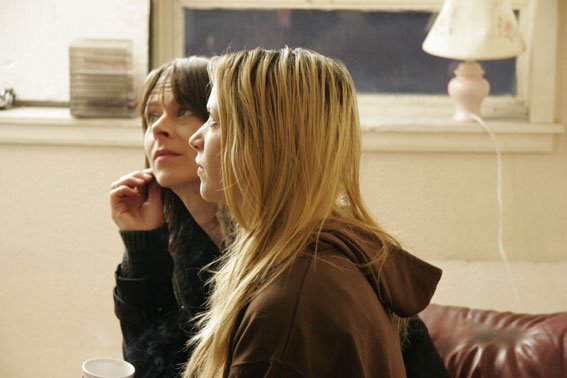
Kate Dickie (left) and Natalie Press in Red Road (image from Verve Pictures -- see below)

I'm often knocked out by movies, so I shouldn't be surprised by Red Road. One of my evening class students raved about it and I can see what she means. Fortunately, I didn't read anything about it first (although I was well aware of its basic scenario and had followed the triumph at Cannes). I was able to watch the film without any preconceptions and it worked a treat.

Since it is part of a Lars von Trier project, it shares a great deal with the Dogme aesthetic. In fact, perhaps because I haven't seen that many Dogme films, I thought it was very similar in impact to Festen. Apart from having a widescreen aspect ratio, I don't see why it couldn't be a Dogme film.

It so refreshing to see a film which simply introduces a character without explaining everything about them. We have to work it out from what we see and hear – appropriate really for a film about a woman who watches CCTV screens all day long. The pace in the beginning is slow but builds to a terrifying sequence -- built largely on characterisation, camerawork, editing and mise en scene.

I was disappointed by Sight and Sound's review. The reviewer assumes a distanced rather superior stance. She starts from the premise that as a viewer, she knows everything and therefore criticises the film's ending. But the way to approach this movie is to invest in Jackie, the lead character, and feel what she feels. I'm sure most audiences will do this and will react to the ending of the film from within a confused state of relief, exhilaration, anger or whatever other emotion is evoked for them.

The IMDB User Comments and Bulletin Boards are interesting. Several users seem upset by the explicit nature of some sex scenes. That's understandable, but not the comments that the two leads are unattractive. They are both excellent and believable. There is also some discussion of Glasgow as a location. I don't know Glasgow that well, but it always strikes me as both invigorating and desperate, a fun place and a fearsome place. It's a great city and the film uses the setting very well. I'd urge anyone to see this film. Well done Andrea Arnold, cast and crew and well done Verve (see website for images and production notes) for getting the film out on 38 prints in the UK. Things are looking up for real British films.

Wednesday, October 25, 2006

Holidays and Bollywood

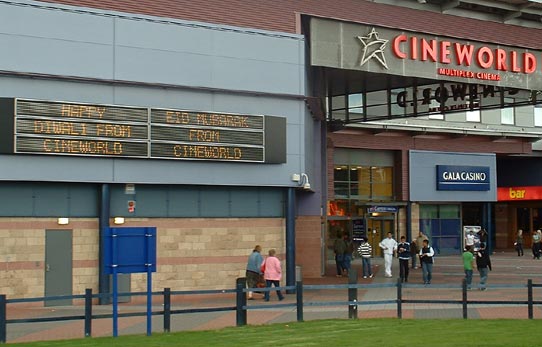
2006 has offered a boost to the marketeers of Bollywood films in the UK -- and provided film and media students with a good example of how film distribution works. The Muslim festival of Eid ul-Fitr celebrates the end of Ramadan, which because it is part of the lunar calendar occurs approx. 11 days earlier each year of the Gregorian calendar. In 2006 Eid was celebrated on 23/24 October in the UK. This coincided with the Hindu festival of Diwali, which also moves in relation to the Gregorian calendar, but always occurs at roughly the same time of year. This year it started on October 21 and lasted for several days.

The coincidence of the two festivals meant that both of the two major UK Asian communities were looking for family celebrations at the same time. The Bollywood distributors held back major releases so that there was nothing playing in Bradford last week, in order to concentrate on the holidays this week when they opened two big films, the romance Jaan-e-maan and the action film Don (a remake of a 1978 Amitabh film with Shahrukh Khan in the lead). An interesting short piece in the Guardian G2 on Monday October 23 by Saima Raza describes how Bradford Asian families now see the Eid festivities as the perfect time to go to the movies.

I went into Bradford yesterday and it was buzzing on an afternoon with changeable weather. Since it's half-term as well, Cineworld was packed and I gave up trying to get a ticket, going to see Zinedine Zidane: A 21st Century Portrait instead. Since the Hollywood offer is pretty dire at the moment (with the exception of The Departed), the two Bollywood films could take up to five screens out of fourteen at various times of the day. It will be interesting to see how the two films fare in the weeks Box Office Top 15.

Sunday, October 08, 2006

Not Cashing In

I enjoyed the Johnny Cash biopic Walk the Line very much. It had some of the best sound of any Hollywood films that I've seen /heard -- the opening sequence at the prison was sensational. I've long been a Reese Witherspoon fan -- Election was a revelation -- and I was equally impressed by Joaquin Phoenix. It was only a few weeks afterwards when I reflected on the BBC4 documentaries on Cash that I started to have some doubts, not about the quality of the film but about the story. Johhny's daughter from his first marriage, Rosanne, was critical of the film and what she thought was a misrepresentation of her mother, Vivian. Rosanne's sister Kathy was also critical, feeling that the film gave the impression that her mother had been a drag on Johnny's career.

This had an impact for me because although I've always liked John R. Cash as a performer, I've always been a bigger fan of Rosanne. After his death in 2003, I bought some albums from the Cash back catalogue and got into him again, but my passion for Rosanne's music from the 1980s had cooled a little. Then I discovered how easy it was to digitise my vinyl LPs. Suddenly I was back into Rosanne's music in a big way (and that of one time husband Rodney Crowell, who produced a lot of her best work). I then debated whether I should acquire her latest album, Black Cadillac. I knew it was written at a time when she was reflecting on the death of not only her father and stepmother June Carter in 2003, but also her mother in 2005 and her step sister. Could I cope with an album completely focused on the death of loved ones? In the end, I was convinced by the reviews and I got the album. What an astonishing piece of work. Deeply moving, but not at all maudlin. It has some of the best melodies and lyrics I've heard for a while and sounds as good as 'Seven Year Ache' or 'King's Record Shop', my favourite 80s albums. Perhaps I'll consider the 90s albums next.