Wednesday, March 14, 2007

Confusion in the ranks


My reaction to Letters from Iwo Jima is one of mild disappointment and confusion. I can see that it is a 'well-made film' and it held my interest for its long running time, but I wanted a clearer sense of what the film was trying to do. Because of its overwhelmingly positive reviews in the US and its apparent popularity in Japan, I guess I have to question my response and attempt to explain it.

I tried to be as objective as possible watching a Clint Eastwood film. In the 1960s and 70s I was a strong Eastwood fan, but I was disgusted by even the concept of Heartbreak Ridge and the only Eastwood films I've paid money to see since are Unforgiven in 1991 and Space Cowboys in 2000. So, I wasn't looking for Eastwood the great American director. Rather, I was intrigued by the Japanese story. We rarely get to see any of the Japanese films about the war in the Pacific in UK cinemas. Based on soldiers' letters and a recent book, the script for the film promised something different.

The film seems to me to offer three different narratives. The slightest is the overview of the Battle of Iwo Jima, accomplished with some rather unconvincing CGI of the American fleet and its powerful air support. This could have been better explained, I think -- or perhaps it is assumed that the rather specialised American audience and all of the Japanese audience already know the precise strategic importance of Iwo Jima in the defence of Japan. Much of the information about the state of the war is given in the exchanges between the Japanese defenders. I know a fair bit about Japanese history, but I needed more than was offered here.

The second narrative is a familiar 'war is hell, but it's also exciting' combat film story. I confess that I didn't find this to be particularly interesting, but it does create a potential problem in the presentation of the other two stories. A full three hour movie about the battle itself with large scale action sequences would have produced a very different kind of film. The much smaller scale action sequences we do get are related to the third story -- the story about the 'beginnings of the end' of the Japanese prosecution of the war against the Allies (OK, mostly the US). This story is told on a personal level through a small group of characters. Now this was potentially a riveting story and I felt the other two stories got in the way.

We learn something about a handful of characters -- the officer commanding the defence played by Ken Watanabe, two of his junior officers, one an aristocratic Olympic equestrian the other seemingly a representative of the right-wing elements in the Japanese officer class, and two privates. One of these is the second lead played by Ninomiya Kazunari, an example of that East Asian phenomenon known as the pop singer who can be a serious actor. He's certainly very good in the role of the reluctant private surviving the war in an almost magical way -- rather like the Good Soldier Schweik as my companion in the cinema suggested. (This is not a direct comparison, but Saigo, the Japanese private does seem an archetypal figure in the squad.) He is counterposed by Shimizu, the genuine 'good soldier' suspected of being a spy, but actually undergoing punishment for not being sufficiently ruthless as a member of the kempeitai (the Japanese equivalent of the Gestapo). These characters are sufficiently different in terms of background and ideology to enable quite a sophisticated analysis of the response to impending failure in the Japanese armed forces. Unfortunately, what we get doesn't go far enough and it is frustrating. I suspect a Japanese audience may get much more because of their greater background knowledge as well as access to colloquial language.

The final question for me is the American attitude to the events in the film. It is noticeable that two of the 'positive' Japanese characters have been to America and can speak English and that the capture of a wounded American soldier is the basis for a sequence demonstrating that the Japanese needed to learn that the Americans were not monsters, but 'human' like the Japanese. Of course, there is a 'real' basis for all of this. Nevertheless, I felt that that the final shot, which if I remember correctly is of the Americans on the beach 'cleaning up' after the battle as the sun goes down, does suggest that the world is a better place for American military power. Again this was almost certainly the case in 1945, but its re-affirmation now is ironic at best. Is this film about the American or the Japanese response to events? To be fair, several American reviews do rehearse arguments about the unusual appearance of an American film about failure/losing the battle -- albeit not an American loss in this instance. Brits are of course quite used to narratives of loss and failure, which we often find more involving.

The film is 'bookended' by contemporary archaeologists discovering the 'Letters from Iwo Jima' never sent home to japan by the commanding officer. This device possibly refers to Saving Private Ryan, but it reminded me more of the South Korean movie Brotherhood (Taegukgi) (2004). In that film the bones of one brother were presented to the other, who at one point fought for the 'other side'. It would have been interesting if Saigo, the 'survivor' of Iwo Jima had gone back to visit the caves he fought in. Overall I found Brotherhood more shocking in its visceral violence and more intriguing/involving as a story. (It was a very big hit in South Korea.)

My main hope is that the success of Letters will prompt Japanese filmmakers to make similar films themselves (or distributors in the UK to obtain rights to existing films about the period). I'm fascinated by national cinemas in which the exploration of relatively recent history is an important cultural project. A few days after Letters from Iwo Jima, I watched The Lives of Others, but that is another story.

Monday, January 29, 2007

Gazing at Venus


Peter O'Toole's Oscar nomination pushed Venus into the limelight at the weekend. I was a little surprised to see a clutch of young people at the back of the cinema when we went to see the film on Saturday. Noisy during the ads and trailers the young audience was quiet through the film. I wonder what they made of it? Since the film caused problems for the middle aged and the late middle aged, it can't have been easy for them.

I confess that I enjoyed this film much more than I was expecting. For the first half I laughed (out loud on several occasions) and then just after halfway I began to weep and continued in an emotional state to the end.

The amazing thing is that so many reviewers seem to have problems with the representations of sexuality in this film. Bradshaw refers to "quasi sex", Kermode said they didn't really deal with sex (i.e. compared to The Mother, another Hanif Kureishi/Roger Michel collaboration). The usually reliable Philip French was disgusted and the even more reliable Jonathan Romney in the Independent on Sunday ducked the issue by reviewing something else. Unfortunately, I haven't noticed any reviews by women yet. Let's face it -- this movie is all about sex and for an audience that recognises this, it is intensely erotic. The Peter O'Toole character is an old man with prostate problems, resulting in a catheter and impotence, but he still has sexual desire and circumstance sets up a relationship with a young Yorkshirewoman (terrific performance by Jodie Whittaker) – a working class lass with beauty and some naivete, uncouth but naturally beautiful, vital and healthy. What follows is a classic sexual encounter between two people each with a power over the other, but also with a longing for emotional contact.

I'll let Bradshaw and co into a secret, sex doesn't have to involve penetration or even physical contact. As someone once said, the most potent sexual organ is the brain. Conversations can be sexual, looking (scopophilia -- this is cinema for heavens sake!) can be sexual. In fact, Venus does go a little beyond this and when O'Toole lifts Jessie's long hair and kisses her neck it's devastating. Hanif Kureishi explains the background to all of this in his article in the Guardian's Saturday Review of 26 January. His inspiration was the work of the Japanese novelist Tanizaki Junichiro who wrote extensively about the sexual desire of older men, particularly in the short novel, Diary of a Mad Old Man (1961). Kureishi explains that he read the novella several times and then "wrote round it", taking the central idea as inspiration. Here is Kureishi on Tanizaki and desire:

"Desire is the devil in Tanizaki, a torment you can never escape or fulfil, except temporarily. Yet without it there is inertia, emptiness, routine. On top of this, particularly as people age and there is less novelty available to them, desire is only sustained by others, by jealousy, rivalry, secrecy and human obstacles. Relief is only ever a reprieve, and the characters are forced towards extinction by their never-ending desire. Tanizaki is not an experimentalist himself; he is a straightforward writer, not a modernist. But his characters' lives become experimental once they engage with what they really want, once they realise they cannot escape their sexuality. Self-knowledge is impossible, foolish even; all you can do is try to follow your body."

I think Kureishi is justified in pointing to other Japanese novels and films as dealing with older people's fears and desires in much more interesting ways than many youth-obsessed Western texts. Philip French actually recognises the connection (perhaps accidentally?) but berates Kureishi and Michel for not being like Ozu and offering a 'humane' study of old age like Tokyo Story. Tokyo Story is indeed wonderful, but is only one of many works by Ozu and several other Japanese directors that represent interesting (and sexual) older men (and yes, it tends to be older men and younger women in the ones I have seen). As more of the work of Ozu, Mizoguchi and others slowly becomes available, I hope to find more time to watch it.

Could this film be used with 16-19 year-olds? I'm not sure, but it certainly offers a text against which to assess the centrality of the male gaze. The whole narrative is about looking and being looked at and although the old man looks at the young girl, this isn't just the powerful looking at the the powerless. One scene at the Royal Court shows O'Toole enjoying watching the girl who is staring at the stage, shocked and fascinated by the characters (young women of her own age) engaged in a 'realistic' argument.

One last point on Venus -- the print looked dreadful. I couldn't work out if it was deliberately gloomy and murky or whether it was badly projected (Vue, Leeds Light). I did note that the image was too big for the screen and a subsequent discussion with a projectionist suggested that the Vue screen had an underpowered projector with insufficient illumination for the screen size. I confess that I did think the screen was too big for the cinema -- usually, it is the other way round.

Friday, January 19, 2007

Guru Mani Ratnam

What a joy to catch the new Mani Ratnam film in the cinema, only tempered by the thought that this film -- from India's premier director -- didn't get reviewed in the UK press. Partly this was because the distributor probably didn't offer a press screening, but even so, you would expect the reviewers of the broadsheets to look out for Mani's films.

It was enjoyable and it's an important film in terms of the story and the performances from Abhishek Bachchan and Aishwaria Rai, but I have to admit that as a Mani Ratnam film it's slightly disappointing lacking some of the sheer bravura of earlier films. I also thought the songs were less memorable. I've looked at several Indian reviews of the film and I'm with the bulk of them. Mani Ratnam often suffers from being too commercial for the cinephiles and too serious for the popular audience (some of yesterday afternoon's tiny audience left before the end). But this could be construed as demonstrating that it is the audience and the industry who need to catch up. I think that Mani may indeed be the Indian director who makes the film that finally breaks Hindi Cinema in American multiplexes (which would be ironic for a Tamil director).

The importance of the story lies in its approach to the history of Indian capitalism. It draws on the career of
Dhirubhai Ambani, founder of Reliance Industries, and offers a picture of how business was conducted before the relatively recent 'liberalisation' of the Indian economy. There is a a discourse of social class running through the film with the central character Gurubhai Desai appealing as a 'villager from Gujerat' for the support of ordinary shareholders rather than the upper middle-class who previously controlled Indian business. My companion at the screening, who has worked in the international petrochemical business, commented that he didn't think such a story could have been told in India until the last few years. Whilst the film works well to expose the corruption and bribery that went on, it also works well as a melodrama of surrogate fathers and sons. There are, however, several plot holes in the melodrama and some characters seem to simply disappear.

There is a detailed entry on the film at Wikipedia and early signs are that it has done very well in India and in North America and Australia. In the UK it ranked 15th on a 44 screen opening with a screen average of over $7,000 (Screen International).

It would be good if someone released Mani Ratnam's earlier work on DVD in the UK. (I was intrigued to see that Time Magazine included Nayakan (1987) on a list of 'all-time' Top 100 films.

Wednesday, January 17, 2007

Awards season

The Golden Globes, the run-up to the Oscars – an interesting exercise in how the industry ('the business' according to yesterday's Guardian) is feeling about itself, the whole process is still annoying in terms of what gets recognised and what doesn't.

People I meet on courses or at events often ask me what I think about this or that film and they seem surprised that I haven't seen such an important film. I'm not sure if this is true for everyone who teaches film, but I certainly don't get to the cinema as often as I would like (lack of organisation, probably) and when I do get to a screening, it's often a film I've booked or I'm considering booking for a course. Although I do often see films for work, I do enjoy seeing films just for fun, but then I choose very carefully. The more hype a film receives, the less I am likely to see it, unless something specific in the promotion (or word of mouth) attracts me. In 2006 I saw just over a film a week at the cinema. Here is the list of titles, leaving out multiple screeenings of the films I used on events:

The Departed, Red Road, Children of Men, Pan's Labyrinth, The Host (S. Korea), Shanghai Dreams (China), Ghost World, A History of Violence, Princess Mononoke, Zidane: A 21st Century Portrait, Man Push Cart, The History Boys, American Psycho, Love + Hate, Tsotsi, Three Times (Taiwan), Tickets, The Wind That Shakes the Barley, The Last Picture Show, Brokeback Mountain, Hi-Lo Country, Volver, Innocent Voices, Kiss Me Deadly, The River (Renoir), The Bad Sleep Well (Kurosawa), Twilight Samurai, An Actor's Revenge (Japan), 36, Down in the Valley, Inside Man, Untold Scandal (S. Korea), Taxi Driver, Confetti, Life is to Whistle (Cuba), The Waiting List (Cuba), Omkara (India), Miami Vice, Pirates of the Caribbean 2, Superman Returns, Marie Antoinette, Shaun of the Dead, La Haine, Sweet Sixteen, Crash, The Three Burials of Melquiades Estrada, Hidden, The Beat That My Heart Skipped, Intimacy, Memories of Murder (S. Korea), My Sassy Girl (South Korea) Nowhere to Hide (S. Korea), Le Doulos, Les Armees des Ombres, Paisa, Dirty Pretty Things, Edward Scissorhands, The Notorious Bettie Page, Walk the Line, A Cock & Bull Story

Out of these, there was only one that wasn't worth the bother – Confetti. From the rest, I can select some possible award winners from this year's releases:

Best debut picture: Red Road for its intensity and roller coaster last third and The Three Burials of Melquiades Estrada for being the best Peckinpah-style movie since Sam went (would be good if the same director and writer tackled Cormac McCarthy's border stories)

Best re-release: Les Armees des Ombres (see my earlier blog entry)

Most enjoyable: Volver

Most adventurous direction: Children of Men – lots of holes in the story, but a brave and technically skilful rendition of the UK in 20 years time with good performances.

Most unjustly ignored in the UK: The Host – the best action film I've seen, a mammoth blockbuster in East Asia, its shunning by UK audiences is shaming.

Most over-rated film: Hidden – supposedly the favourite film for discussion around the dinner tables of North London. Certainly a well-made film with good performances and a couple of stunning moments, but I sense an emptiness where it purports to be saying something profound.

Best picture: Pan's Labyrinth. A wholly deserved triumph for Guillermo del Toro – perhaps someone will now re-release The Devil's Backbone on 35mm, since it disappeared soon after its first outing.

2007 has started well and A Prairie Home Companion was hugely enjoyable and a fitting send-off for Robert Altman.


Wednesday, January 03, 2007

Something worth watching on television?


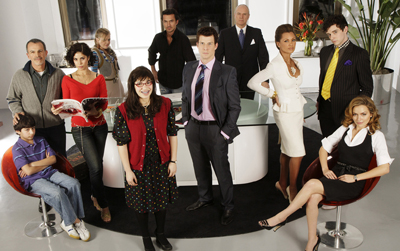
I've almost given up on mainstream television. Apart from Match of the Day there isn't much that I'll try hard to watch. The last show that I really looked forward to was Victoria Wood's adaptation of Nella Last's wartime diaries (which didn't disappoint). I did enjoy Helen Mirren in Prime Suspect and I'm looking forward to the second series of Life on Mars, but I'm most interested in the start of Ugly Betty on Channel 4 on Friday.

Ugly Betty has been one of the few new shows to make an impact on ABC in the US in Autumn 2006. It's the first American attempt to create a telenovela. The telenovela is a uniquely Latin American televisual form that has successfully sold around the world (except, so far, in the UK). I've not watched one beyond a few minutes, but I've been aware of their fascination for audiences in countries I've visited. Pitched midway between a serial (i.e. a literary adaptation spread over several episodes) and a continuous serial (i.e. a soap), telenovelas typically run for a couple of years but then the narrative reaches a conclusion. Ugly Betty is based on a Columbian telenovela, Yo soy Betty, la fea, which ran from 1999-2001 with 169 episodes. Fantastically popular in Latin America, the show was remade in Mexico and then by Disney (Touchstone). The US version is listed as 60 mins per episode (less the ad breaks), but IMDB lists both 30 mins and 45 mins for the running time in Mexico. It's a Cinderella story about the 'plain' girl who goes to work for a fashion magazine. Channel 4 is advertising it as a comedy, but I suspect it is much more. It has (in the UK) been discussed in terms of the recent hit film The Devil Wears Prada, but of course its story predates the film.

Betty is played by America Ferrera, who began her career as the lead in Real Women Have Curves, an HBO film that won awards at Sundance in 2002 and launched America's career as one of the new young Latina stars in the US. I've enjoyed using Real Women with students and that's partly why I'm looking forward to the telenovela. The Mexican star Salma Hayek, who has been used (and misused?) by Hollywood appears in the first few episodes of Ugly Betty (at first as an actor in the telenovela that the Suarez family watches at home) and as an executive producer she was instrumental in the casting of America Ferrera (see the abc website for a video chatshow segment of Hayek and Ferrera). There seem to be other Hispanic-Americans also involved in the show and I'm intrigued to see how far Hollywood will go in embracing Hispanic culture for mainstream television. Hayek makes the point about the melodrama of the telenovelas -- can't wait.

I hope the show is a hit in the UK and draws a different demographic mix to Channel 4. The Wikipedia entries on the show are very detailed and useful for any classroom work.

Thursday, December 14, 2006

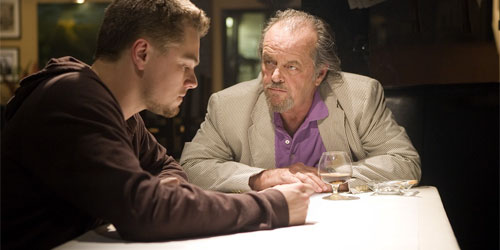
The Departed


Finally managed to catch The Departed before it disappeared from the big screen. I'm not sure what I think of it. Having seen and enjoyed Infernal Affairs in the cinema, there was nothing quite as startling in Scorsese's film.

Having read several reviews, I think I'm with J. Hoberman in Village Voice. The Departed is much longer than Infernal Affairs but it doesn't do a great deal more. It is, of course, extremely well-made and very enjoyable as a genre film, but tight and lean it isn't. It also lacks , for me, real interest in characters. I was prompted to think of a movie I love a great deal -- Donnie Brasco (1997) in which Johnny Depp plays the undercover cop and Al Pacino the low grade mafioso who becomes his surrogate father. By packing The Departed with the likes of Jack Nicholson and Martin Sheen, Scorsese seems to be going for depth in the playing, but Nicholson can't for me achieve the force of Pacino and Depp is leagues ahead of Matt Damon, DiCaprio (one of his better performances) and Mark Wahlberg (an odd and well received performance). I worry that it is my own old man's view and also possibly my arthouse snobbery, but no-one in The Departed gets within ten miles of Tony Leung, so cool he is frozen.

I think Marty got caught between two stools with this movie. It should have been shorter, tighter and more generic without big stars or more psychologically profound/more melodramatic (I did like Vera Farmiga, whose part could have been expanded).

So, I enjoyed the film but it could have been more. Rather like Michael Mann with Miami Vice, Scorsese knows so much that when he doesn't blow your socks right off it is a little disappointing. It is probably flying in the face of all reason and most polls, but I found both Gangs of New York and The Aviator to be more exciting in terms of watching a great filmmaker stretch himself.

Wednesday, November 29, 2006

Digital comparisons


First chance last week to compare, on a big cinema screen, a new digital print with its 35mm celluloid version. In 1986 I was lucky to work with the newly restored National Film Archive print of Black Narcissus (1947). We made slides directly from the print on a Steenbeck in the basement of the BFI. I certainly got to know the print well and so I was fascinated to see the digital version. Overall, the digital print is beautiful, clean and bright. But perhaps it is too clean and too bright? I particularly noticed three examples of 'over clarity'. There are many close-ups in the film, especially of Deborah Kerr as Sister Clodagh. Her eyes sparkle with reflected light but it gets a little spooky when the shot is faded out and two sparks of light remain as a kind of afterglow, long after the rest of the image has gone to black. Much more disturbing is the way that the digital print exposes all the matte work so that the imaginary kingdom of Mopu, with its palace perched on a shelf above a vertical drop, looks just like a studio set joined together by flourescent turquoise cement that pulsates gently drawing even more attention to the join. Finally, I noticed that the painted still images of the mountains now look exactly that -- painted images, seemingly with some damage from the ravages of time.

Black Narcissus is one of the most beautiful films ever made (a double Oscar winner for colour cinematography and art direction in 1947) so a process that exposes some its magic is not all good news. On the other hand, it won't deteriorate any further in the near future. The jury is still out on digital.

(The image is from a first generation DVD copy of the film.)

Monday, November 06, 2006

Red Road

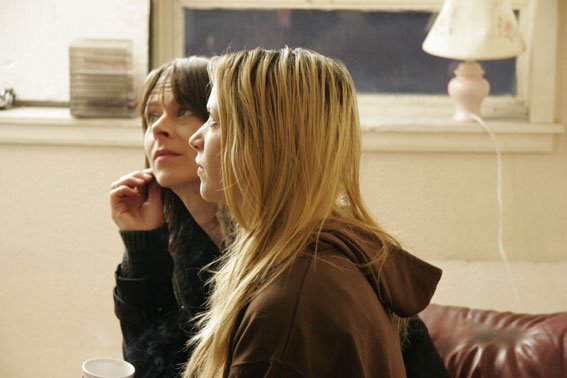
Kate Dickie (left) and Natalie Press in Red Road (image from Verve Pictures -- see below)

I'm often knocked out by movies, so I shouldn't be surprised by Red Road. One of my evening class students raved about it and I can see what she means. Fortunately, I didn't read anything about it first (although I was well aware of its basic scenario and had followed the triumph at Cannes). I was able to watch the film without any preconceptions and it worked a treat.

Since it is part of a Lars von Trier project, it shares a great deal with the Dogme aesthetic. In fact, perhaps because I haven't seen that many Dogme films, I thought it was very similar in impact to Festen. Apart from having a widescreen aspect ratio, I don't see why it couldn't be a Dogme film.

It so refreshing to see a film which simply introduces a character without explaining everything about them. We have to work it out from what we see and hear – appropriate really for a film about a woman who watches CCTV screens all day long. The pace in the beginning is slow but builds to a terrifying sequence -- built largely on characterisation, camerawork, editing and mise en scene.

I was disappointed by Sight and Sound's review. The reviewer assumes a distanced rather superior stance. She starts from the premise that as a viewer, she knows everything and therefore criticises the film's ending. But the way to approach this movie is to invest in Jackie, the lead character, and feel what she feels. I'm sure most audiences will do this and will react to the ending of the film from within a confused state of relief, exhilaration, anger or whatever other emotion is evoked for them.

The IMDB User Comments and Bulletin Boards are interesting. Several users seem upset by the explicit nature of some sex scenes. That's understandable, but not the comments that the two leads are unattractive. They are both excellent and believable. There is also some discussion of Glasgow as a location. I don't know Glasgow that well, but it always strikes me as both invigorating and desperate, a fun place and a fearsome place. It's a great city and the film uses the setting very well. I'd urge anyone to see this film. Well done Andrea Arnold, cast and crew and well done Verve (see website for images and production notes) for getting the film out on 38 prints in the UK. Things are looking up for real British films.