Showing posts with label Hollywood. Show all posts

Tuesday, October 02, 2007

Who is The Brave One?


The answer to the question may be Jodie Foster who stars in The Brave One. It might be Neil Jordan for taking on the direction. Both of them risked a critical mauling, but seem to have been rescued at the pass by the great American audience. I'm not sure if it is the prospect of this audience or the film itself which frightens me more. I've rarely been so exercised by a film.

I'm a Jodie Foster supporter, though I haven't seen that many of her films. I could say much the same about Neil Jordan, whose Hollywood pictures have never attracted me as much as the Irish/British ones. Putting the two together should promise something worthwhile. And indeed, for most of this film, Foster is excellent and Jordan provides several standout sequences. The script, however just isn't up to the job for me. As several critics have pointed out, the problem lies somewhere in the film's reference to genre repertoires. If The Brave One is judged as a 'revenge' thriller, it falls far short of the narrative economy and sheer drive of Abel Ferrara's Ms 45. I've not seen Death Wish, but I've read suggestions that it too is superior as a genre/expoitation film (whatever may be the worries about its politics). The Brave One wants to be more than an exploitation film but it lacks the clear sense of purpose that a film like A History of Violence offers. Instead, it features various subplots like the potential romance between cop and victim/avenger (prompting references to Jane Campion's In the Cut, a film which itself has genre problems, but which overall is more coherent) and the cod philosophy associated with a protagonist who is a very rare breed, a radio soundscape designer cum commentator. These aspects of the film mean it has the potential to be an interesting character study.

But I have to own up. My real problem is with American politics and gun control (the lack of it – the Jodie Foster character gets around it immediately). As a European, I just can't take seriously a film with no sense of moral purpose whatsoever apart from the belief that this 'good person' can do whatever they need to do to regain their confidence after a brutal attack. So, people are killed as if they were not human beings and a supposedly liberal character and a police officer can ignore the law without any sense of loss or any impact on their sense of moral well-being or mental health. In 1983, Tony Garnett, best known as a producer for Ken Loach, directed his second feature, Handgun, set in America and featuring a woman who is raped and who buys a gun seeking revenge. I don't remember the film in any detail, but I'm sure it was a considered argument against the use of firearms. In one of the more obvious role models for The Brave One, the Scorsese/Schrader Taxi Driver from 1976, there is a single major shootout, a psychotic protagonist and a deeply moral and disturbing take on American urban culture at the time of the withdrawal from Vietnam. In The Brave One there is a mention of Iraq and a character representing the terrors of wars in Africa where children are armed and trained to kill their parents (I'm assuming the character who makes this comment is from Sierra Leone). There are, I think, eight killings in The Brave One that are apparently 'justified'.

If you want to get depressed, read the IMDB comments. The first one I read that made a concerted attack on the film's politics as rightist ended up by claiming that it would be supported by "rabid feminists". As the Americans say, 'Go figure!'.

Wednesday, March 14, 2007

Confusion in the ranks


My reaction to Letters from Iwo Jima is one of mild disappointment and confusion. I can see that it is a 'well-made film' and it held my interest for its long running time, but I wanted a clearer sense of what the film was trying to do. Because of its overwhelmingly positive reviews in the US and its apparent popularity in Japan, I guess I have to question my response and attempt to explain it.

I tried to be as objective as possible watching a Clint Eastwood film. In the 1960s and 70s I was a strong Eastwood fan, but I was disgusted by even the concept of Heartbreak Ridge and the only Eastwood films I've paid money to see since are Unforgiven in 1991 and Space Cowboys in 2000. So, I wasn't looking for Eastwood the great American director. Rather, I was intrigued by the Japanese story. We rarely get to see any of the Japanese films about the war in the Pacific in UK cinemas. Based on soldiers' letters and a recent book, the script for the film promised something different.

The film seems to me to offer three different narratives. The slightest is the overview of the Battle of Iwo Jima, accomplished with some rather unconvincing CGI of the American fleet and its powerful air support. This could have been better explained, I think -- or perhaps it is assumed that the rather specialised American audience and all of the Japanese audience already know the precise strategic importance of Iwo Jima in the defence of Japan. Much of the information about the state of the war is given in the exchanges between the Japanese defenders. I know a fair bit about Japanese history, but I needed more than was offered here.

The second narrative is a familiar 'war is hell, but it's also exciting' combat film story. I confess that I didn't find this to be particularly interesting, but it does create a potential problem in the presentation of the other two stories. A full three hour movie about the battle itself with large scale action sequences would have produced a very different kind of film. The much smaller scale action sequences we do get are related to the third story -- the story about the 'beginnings of the end' of the Japanese prosecution of the war against the Allies (OK, mostly the US). This story is told on a personal level through a small group of characters. Now this was potentially a riveting story and I felt the other two stories got in the way.

We learn something about a handful of characters -- the officer commanding the defence played by Ken Watanabe, two of his junior officers, one an aristocratic Olympic equestrian the other seemingly a representative of the right-wing elements in the Japanese officer class, and two privates. One of these is the second lead played by Ninomiya Kazunari, an example of that East Asian phenomenon known as the pop singer who can be a serious actor. He's certainly very good in the role of the reluctant private surviving the war in an almost magical way -- rather like the Good Soldier Schweik as my companion in the cinema suggested. (This is not a direct comparison, but Saigo, the Japanese private does seem an archetypal figure in the squad.) He is counterposed by Shimizu, the genuine 'good soldier' suspected of being a spy, but actually undergoing punishment for not being sufficiently ruthless as a member of the kempeitai (the Japanese equivalent of the Gestapo). These characters are sufficiently different in terms of background and ideology to enable quite a sophisticated analysis of the response to impending failure in the Japanese armed forces. Unfortunately, what we get doesn't go far enough and it is frustrating. I suspect a Japanese audience may get much more because of their greater background knowledge as well as access to colloquial language.

The final question for me is the American attitude to the events in the film. It is noticeable that two of the 'positive' Japanese characters have been to America and can speak English and that the capture of a wounded American soldier is the basis for a sequence demonstrating that the Japanese needed to learn that the Americans were not monsters, but 'human' like the Japanese. Of course, there is a 'real' basis for all of this. Nevertheless, I felt that that the final shot, which if I remember correctly is of the Americans on the beach 'cleaning up' after the battle as the sun goes down, does suggest that the world is a better place for American military power. Again this was almost certainly the case in 1945, but its re-affirmation now is ironic at best. Is this film about the American or the Japanese response to events? To be fair, several American reviews do rehearse arguments about the unusual appearance of an American film about failure/losing the battle -- albeit not an American loss in this instance. Brits are of course quite used to narratives of loss and failure, which we often find more involving.

The film is 'bookended' by contemporary archaeologists discovering the 'Letters from Iwo Jima' never sent home to japan by the commanding officer. This device possibly refers to Saving Private Ryan, but it reminded me more of the South Korean movie Brotherhood (Taegukgi) (2004). In that film the bones of one brother were presented to the other, who at one point fought for the 'other side'. It would have been interesting if Saigo, the 'survivor' of Iwo Jima had gone back to visit the caves he fought in. Overall I found Brotherhood more shocking in its visceral violence and more intriguing/involving as a story. (It was a very big hit in South Korea.)

My main hope is that the success of Letters will prompt Japanese filmmakers to make similar films themselves (or distributors in the UK to obtain rights to existing films about the period). I'm fascinated by national cinemas in which the exploration of relatively recent history is an important cultural project. A few days after Letters from Iwo Jima, I watched The Lives of Others, but that is another story.

Thursday, December 14, 2006

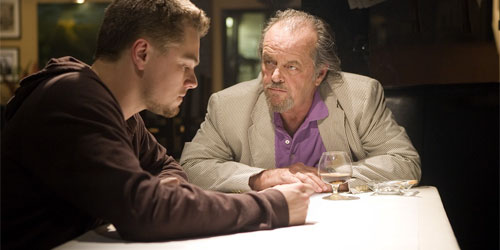
The Departed


Finally managed to catch The Departed before it disappeared from the big screen. I'm not sure what I think of it. Having seen and enjoyed Infernal Affairs in the cinema, there was nothing quite as startling in Scorsese's film.

Having read several reviews, I think I'm with J. Hoberman in Village Voice. The Departed is much longer than Infernal Affairs but it doesn't do a great deal more. It is, of course, extremely well-made and very enjoyable as a genre film, but tight and lean it isn't. It also lacks , for me, real interest in characters. I was prompted to think of a movie I love a great deal -- Donnie Brasco (1997) in which Johnny Depp plays the undercover cop and Al Pacino the low grade mafioso who becomes his surrogate father. By packing The Departed with the likes of Jack Nicholson and Martin Sheen, Scorsese seems to be going for depth in the playing, but Nicholson can't for me achieve the force of Pacino and Depp is leagues ahead of Matt Damon, DiCaprio (one of his better performances) and Mark Wahlberg (an odd and well received performance). I worry that it is my own old man's view and also possibly my arthouse snobbery, but no-one in The Departed gets within ten miles of Tony Leung, so cool he is frozen.

I think Marty got caught between two stools with this movie. It should have been shorter, tighter and more generic without big stars or more psychologically profound/more melodramatic (I did like Vera Farmiga, whose part could have been expanded).

So, I enjoyed the film but it could have been more. Rather like Michael Mann with Miami Vice, Scorsese knows so much that when he doesn't blow your socks right off it is a little disappointing. It is probably flying in the face of all reason and most polls, but I found both Gangs of New York and The Aviator to be more exciting in terms of watching a great filmmaker stretch himself.

Sunday, July 09, 2006

Brokeback Mountain and the Twilight Western Part 2

People often make very interesting points in discussion, but if you are leading the group in a teaching context it is often difficult to remember all the points that are being made. I'm glad this weekend that I did remember a very interesting observation. This was the suggestion that the decline of traditional cowboy employment prospects post 1945 was similar in effect to the decline in mining communities in the UK (and much of the rest of Western Europe) in the last thirty years. A distinct working-class community with a particular way of life and a rich culture felt cast by the wayside. I wonder how a film about two gay miners coming to terms with modernity would have gone down?

Friday, April 14, 2006

Looking Over Brokeback Mountain

I'm intrigued by the success of Brokeback Mountain. In fact, it has to some extent restored my faith in audiences. Several of the people I have discussed the film with are not fans of the Western and were surprised when I suggested that Ang Lee's triumph was to so skilfully make use of the conventions of the Western genre – and specifically those of what some have termed the 'Twilight Western'. This term can be used to describe either Westerns set in the dying days of the 'Old West' (i.e. 1890-1910) or in the post-1945 period when the Western lifestyle began to feel more and more out of tune with contemporary America. In the main, Twilight Westerns have been produced by Hollywood (and independents) since the late 1960s, although earlier examples include The Lusty Men (Nicholas Ray 1952) and Ride the High Country (Sam Peckinpah, 1962).

I've been running an evening class with the title 'Looking Over Brokeback Mountain' at the National Museum of Photography, Film and Television in Bradford for the last few weeks. So far we've watched The Last Picture Show (dir. Peter Bogdanovich, 1971) and extracts from a range of films including Red River (Howard Hawks, 1948) Johnny Guitar (Nick Ray, 1953), Hud (Martin Ritt, 1962), Junior Bonner (Peckinpah, 1972), Desert Hearts (Donna Deitch, 1985) and The Ballad of Little Jo (Maggie Greenwald, 1993).

We've discussed gender in the Western in both the traditional 'mythologised West' and the more realist 'Twilight West' and this week we look at a little-seen Twilight Western, Stephen Frears' 1998 film, The Hi-Lo Country. I wonder how it will look in 2006 after the success of Brokeback? Billy Crudup and Woody Harrelson play the two young men, but this time they fall out over Patricia Arquette.

The course has also prompted me to read Annie Proulx's short story collection and I've enjoyed all the stories so far – I'm saving up the Brokeback story for the last week of the course.

Sunday, April 02, 2006

Spike Lee: Inside Man

Spike Lee certainly upsets people. I can understand the charges of misogyny and even the complaints of those who can't cope with any kind of expressionism or melodrama. I can agree that he is an uneven filmmaker, but surely it's obvious that he's one of the most important filmmakers in Hollywood? Not to Peter Bradshaw in the Guardian. I've never come across a reviewer so annoying as Bradshaw. He's obviously intelligent and perceptive and seems to have seen a wide range of films, but he has no sense of judgment. One star for Inside Man and dismissal of 25th Hour. Nuff said!

Inside Man
is terrific entertainment. The cast is to die for – I think I could cope with anything that put Denzel Washington and Jodie Foster in the front line and supported them with Chiwetel Ejiofor, rapidly becoming a Hollywood regular. I was also impressed with Clive Owen – thankfully not to be wasted on Bond films.

Is Inside Man more than 'just' an 'entertainment'? It struck me during the film that it seems to draw heavily on the treatment of suspects at Guantanamo. The plot means that a large group of hostages in a bank heist are dressed in 'coveralls'. The police are unable to distinguish the 'witnesses' from the 'crooks' and ship them off in a bus. Given jokes about Bin Laden and a Sikh witness' complaint at being addressed as an 'arab' and the references start to pile up. Added to this Spike has chosen as opening and closing music the song 'Chaiyya Chaiyya' written by the maestro A. R. Rahman for Mani Ratnam's Dil Se. Dil Se features Sharukh Khan as a journalist who falls in love with a 'freedom fighter' from Assam. To add further significance, the version of the song that closes the film includes the Coventry rapper Panjabi MC delivering lines in a distinctive West Midlands accent. If you've seen the Revolution Films production of The Road to Guantanamo about the Tipton Three it doesn't take too much to make the connection.

I've no idea whether this is what Spike intended, but it worked for me. Panjabi MC is the third UK creative talent on the roster. Chiwetel manages something approaching an American accent, but Clive Owen, like the rapper, is distinctively British – weirdly noone comments on this.