Showing posts with label Indian Cinema. Show all posts
Showing posts with label Indian Cinema. Show all posts
Monday, April 14, 2008
Telegu Film
A Telegu language film, Jalsa, appeared in this week's Screen International "International Box Office Chart" at No 22 with a release on 454 screens across seven territories for a total of $4.6 million. I'm interested to see these figures which challenge the too common view outside India that only Hindi films matter in Indian Cinema. I also came across an old (1980) copy of the Guinness Book of Film Facts which had an entry on the long lists of Indian languages in which films have been made and which confirmed Tamil and Telegu as the languages with most productions in that year.


Monday, August 13, 2007
Provocation
 Lisa Ray and John Abraham in Water.
I finally managed to see Deepa Mehta's Water (Canada/India 2005) and I surprised myself by being quite moved by the film which deals with a clash between the tradition of widows being effectively imprisoned for the rest of their lives and the possibility of change in India coming from Ghandian political ideas. The focus of the narrative is a romance between a young widow and a law student and its impact on two other widows. My sense was that, despite the controversy which caused production in India to be stopped and moved to Sri Lanka and the film's subsequent success in gaining an Oscar nomination, the UK reviews were rather lukewarm. I remember enjoying Fire (1996), the first of the 'elemental trilogy', but also finding it a strange Indian/Western hybrid. I'm intending to watch Earth (1998) later this week.
Water, I was convinced, was an Indian film. I didn't research the film before I watched it so I wasn't aware that it had been filmed in Sri Lanka. However, I did get a sense during the screening of watching landscapes in South India rather than on the Ganges. Lisa Ray and John Abraham were new to me. I can understand some of the comments about the realism question. Both actors are very beautiful and their parentage (Ray is Indian/Polish and Abraham is Iranian/Indian Christian) means that they look exotic in an Indian setting. But really it isn't a problem and in a way their casting adds another level of meaning to any reading of the narrative. I was also surprised to be offered a selection of A. R. Rahman songs. At least one of these was mixed badly in the film print I watched, but overall they seemed to work.
The big issue, of course, is whether the film works in the same way in the West as in India. On IMDB, the Canadian reviews are generally excellent, partly pride in Canadian Cinema, partly a Western liberal response to the plight of widows in 1930s India, I guess. IMDB reviews and comments by Indians on the other hand are sometimes extremely negative. I attribute this to the obverse of the Canadian response -- a feeling that the filmmaker has somehow betrayed Indian culture/is not proud of Indian Cinema, but also from a Hindu perspective, the film is disrespectful of religious teachings. There is a great deal about the controversy over Water scattered across the internet and I don't particularly want to get embroiled in the politics of Hindu Nationalism. What interests me here is what the Indian critics have to say about the film -- as a film. I came across this blog, seemingly by an NRI/desi with deep knowledge of Indian 'parallel cinema', that offered a withering appraisal -- much of it focusing on aspects of the film requiring cultural knowledge. For instance, the spoken Hindi in the film is 'stilted' and doesn't convey any authenticity. Similarly, the saris are polyester, the taxis in the street are wrong, the costumes are wrong and so is the representation of Ghandi at the end of the film. The blogger is angry with the film on nearly every level, including what is seen as a crass use of quotes from Hindu writings. Overall, the blogger pines for the directors and stars of parallel cinema. Lisa Ray and John Abraham are criticised for their acting. I'm always worried by these criticisms since appraisal of acting styles is often highly subjective. However, I can see that the film would have been very different if Shabana Azmi and Nandita Das had appeared as the two adult widows (the third widow is a child) as Deepa Mehta originally intended. (A report on the original shoot with an image of Azmi and Das is on this Bright Lights Film Journal page.)
I wish my knowledge of parallel cinema was more extensive, but I've seen quite a few and Water wouldn't stand up to a comparison with the films of Satyajit Ray, Ritwik Ghatak, Mrinal Sen or of Shyam Benegal. There were moments when the scenario and some aspects of the cinematography reminded me of those earlier films (I think it's the second film of the Apu Trilogy from Ray, Aparajito (1956) which features the ghats of Benares) but overall Deepa Mehta's aim was different. Like Mira Nair, she is trying to make films about Indian culture for both a Western audience and a younger popular audience in India. And on this score, according to a number of Indian reviews, she seems to have succeeded. The film is: "Art without being arty, which is truly rare and wonderful" as one young Indian blogger puts it. This doesn't negate the cultural criticism (and I did find more) and I think that is a weakness. On the other hand, shifting production to Sri Lanka must have been a nightmare and to manage to acheive what she has in the circumstances deserves support. To attract audiences to a consideration of social issues, even if it involves some misunderstandings is something Bollywood hasn't managed. Despite the criticisms some Indians seem to have supported Water as an Oscar contender (as the Canadian foreign language entry) over the Indian entry Rang De Basanti -- I guess I should see that soon and look at a comparison.
Saturday, July 21, 2007
Holiday viewing
 Watching movies on a plane is at best a welcome diversion from the tedium of flying. On a long-haul flight it becomes more attractive. Even so, it isn't the best basis for commenting on individual films. The screen is tiny on the back of the seat in front, the aspect ratio is usually wrong and there are constant interruptions. Even so I was grateful to see a Hindi movie (with English subtitles) on a flight to Nairobi, thanks to the selection of films on offer by Kenya Airways. Khosla Ka Ghosla (India 2006) proved to be a gentle and enjoyable social comedy, an almost 'pure' genre film with none of the usual trappings of Bollywood. A middle-class father is approaching retirement and the day has come when he has finally purchased a plot of land on which to build the family home of his dreams. However, he is conned out of the land by an unscrupulous builder/speculator who claims to have already purchased the same land and who has the legal resources to defend his claim. The key character in the ensuing comic narrative is the second son 'Cherry' – a young computer executive not really interested in the family and preparing to take up a career opportunity in North America. But, of course, at the last minute he can't see his father humiliated so he attempts to help. The strategy that is finally adopted seems almost Ealingesque. Cherry's girlfriend is an actor and she recruits her teacher and his son to effectively become con artists and to trick the evil speculator into 'buying' land that belongs to a government agency.
I thought the acting all round was very good and I thought I recognised some actors. Checking on IMDB, I found the father had also played the father in Bend It Like Beckham and the son had been the bridegroom in Monsoon Wedding.
On the return flight, slightly miffed that the Chinese (Hong Kong) movie showing on Boeing 767 services was not available on the 777 flight, I decided to try out the Hollywood studio offerings. It was probably meaningless to watch Casino Royale on such a tiny screen, but the action was certainly well staged and Daniel Craig is a decent performer. However, I found the plot incomprehensible at times. After spending a fortnight in Tanzania, I felt I really should look at The Last King of Scotland and how it captured events in Uganda in the 1970s. I had avoided watching the film in the cinema because I just didn't fancy the story. All the clips I'd seen just made me wince. The film has been highly praised, not just for Forest Whitaker's performance but also for the gradual development of what seems like a light-hearted story into the nightmare of Idi Amin's presidency. Well, I gave it twenty minutes or so and it just didn't work for me (which may have been a result of sleep deprivation). I just couldn't believe in the James McAvoy character at all. I know this young actor is highly regarded and the profiles of him suggest he is a good guy, but he still looks like a clever schoolboy to me. I found Whitaker as Amin almost impossible to take. The IMDB entry on the film carries several interesting comments (and several stupid ones) and one young viewer suggests that the film worked precisely because he had no knowledge of Amin at all. Therefore the gradual revelation was very effective. I remember Amin very well and he wasn't funny (although he was certainly widely satirised, I think).
I'll have to give the film another go at a later date. The same goes for Hotel Rwanda.
Monday, June 25, 2007
Tamil film in the UK Top Ten
 The Top 10 films in the UK for the weekend of June 16/17 included two Indian films. At No 6 the Hindi film Jhoom Barabar Jhoom registered a screen average of over £5,000 from 47 screens. There is nothing unusual about this as Hindi films regularly feature in the Top 10. However, at No 9 Sivaji represents what I think is the first Tamil (i.e. 'made in Chennai') film to register. Not only is it in the Top 10, but from only 12 screens with a screen average of over £14,000 it was easily the best earner of the weekend, beating all the Hollywood blockbusters. I rate this the most surprising result I've seen in many years of logging the chart.
Sivaji stars the veteran (57 year-old) superstar Rajnikanth in a story about a software engineer who returns from America to attempt to set up a hospital for the poor. IMDB lists the film as being partly shot in all four South Indian languages: Tamil, Kannada, Telegu and Malayalam. Distributor Ayngaran is the only outlet for South Indian movies in the UK and it must be delighted by its success, which as far as I can see is based on screenings in Cineworld cinemas in London. I confess that the movie sounds like it will not necessarily be attractive to UK audiences not steeped in South Indian culture and it is possibly not subtitled. Nevertheless, this is a breakthrough in revealing to UK film pundits that actually South India produces more films and sometimes has bigger audiences than the Hindi film industry based in Mumbai (i.e. 'Bollywood').
Sivaji opened in 15 territories worldwide and the diaspora audiences in Malaysia and elsewhere propelled to number 15 in Screen International's worldwide chart.
Sunday, June 17, 2007
Mani Ratnam's Yuva
 Somehow, I found the time to watch one of the Mani Ratnam films I'd collected. Yuva (2004) represents something that used to happen in European Cinema in the 1920s and early 1930s quite regularly, but only rarely since – the same script made almost simultaneously in two different languages with different actors. Yuva is the Hindi version of a Tamil film produced by Ratnam's Madras Talkies. An accident delayed shooting on one film and both versions ended up opening on the same day.
The Hindi version did make it to the UK but I missed it. I found a DVD on the Lovefilm rental site. It's a poor quality DVD with a low resolution image, poor sound and dreadful English subtitles – not only with woeful spelling and grammar, but also out of synch with the images. It's very difficult to work out who is saying what to whom. The fact that I still enjoyed the film very much is a tribute to the professionalism of the creative team.
Yuva is an important film for several reasons -- even though it seems to have flopped at the box office. The title refers to 'youth', I think, though the youngest of the lead actors was about 26 in 2004. The story involves the chance meeting of three men on the Howrah Bridge in Kolkotta. As with his earlier film, Alai Payuthey (2000), the opening incident then moves into flashback to tell the stories behind the meetings before returning to the 'present' for the last hour (160 mins movie). The three men represent different class positions and different basic ideologies and the story focuses upon the attempts by student politicians to take a stand against a corrupt party machine. The great Om Puri, so well known in the UK, plays the politician villain to perfection.
The film is star studded, although I've seen comments that suggest that for Abhishek Bachchan, this film was very important since by accepting a 'heavy' role, he widened his range successfully. I did feel that the other actors were familiar, but it was only afterwards that I realised that three of them were in the Othello adaptation, Omkara (2006).
There is a great deal of violence in the film and the finale is rather cartoon-like. However, the violence is necessary, I think, and I thought Bachchan made an excellent villain. There are three aspects of the film I really liked. One was the political narrative and the way in which the script touched on what I take to be current political issues across India. The second was the range of songs and I loved the 'political' song sequence. Ratnam does seem to use song sequences differently than in mainstream Hindi films. Finally, it was just great to see a film set in Kolkotta. Several commentators have complained that only Om Puri managed a Bengali accent. I'm not equipped to spot that, but I appreciated the views of the city (although I noted that thanks went to Southern Railways, so I wondered how much footage was shot in Madras?). I realise that although over the years I have seen quite a few Bengali films, they have all been art films or 'parallel cinema' films. This was the first Hindi film I'd seen set in the city and it was good to see it soon after The Namesake. What a treat too to see trams and the metro as well as trains – Mani Ratnam's films seem full of scenes on public transport of all kinds as well as motorbikes and cars.
There is an interesting review of the film on this American university site, although I'm not sure that I totally agree with its analysis of the closing sequence of the film. It does seem odd that Ratnam chose to set the political narrative in West Bengal, although if he had to transpose it from the south, it probably makes more sense than placing it in other northern states. I suspect that I need to know much more about Bengali political parties to read the ending properly.
I'm going to try another Ratnam film soon.
Wednesday, May 30, 2007
Going domestic in East Asia
In the week that Pirates of the Caribbean opened to record business on 17,500 screens in 102 territories, it's worth noting that it isn't all going Hollywood's way. In 2006, Japan and China joined India and South Korea as major territories in which the domestic film industry managed to achieve 50% of domestic box office. If you want to know what kinds of films these industries are producing, a good starting point is Leung Wing-Fai's review of the 2007 Far East Film Festival in Udine, which we are honoured to present on the in the picture website. Fai wasn't that impressed with what was on offer, but "telling it like it is" is part of her style. What's clear is that these industries function much like other commercial industries and we need to keep track of the range of their ouputs.
2007 looks like a good year for Hollywood, but it is increasingly looking towards East Asian markets -- the Pirates franchise brought in Hong Kong superstar Chow Yun-fat for the latest instalment. The latest MPAA figures suggest that Hollywood's share of the global market has been falling. Partly this is because some territories are growing fast (e.g. Russia) and partly because the difficulties of collecting box office figures in many territories have led to an underestimation of some national totals. In 2006, MPAA quotes a global market for cinema of $25.8 billion with US on $9.49 billion and East Asia on $6.32 billion (an increase of 15% over 2005-6).
2007 looks like a good year for Hollywood, but it is increasingly looking towards East Asian markets -- the Pirates franchise brought in Hong Kong superstar Chow Yun-fat for the latest instalment. The latest MPAA figures suggest that Hollywood's share of the global market has been falling. Partly this is because some territories are growing fast (e.g. Russia) and partly because the difficulties of collecting box office figures in many territories have led to an underestimation of some national totals. In 2006, MPAA quotes a global market for cinema of $25.8 billion with US on $9.49 billion and East Asia on $6.32 billion (an increase of 15% over 2005-6).
Tuesday, May 15, 2007
What's in a name?
 I've rarely been so engaged by a film as I was by The Namesake. What I mean is, that I was at the same time enjoying the story and the characterisation, wishing I was in Calcutta, remembering visiting the Taj Mahal, reliving Satyajit Ray and Ritwik Ghatak films and occasionally being irritated by the American characters (and possibly cross because they seemed a little too much of a type when the central couple were so beautifully drawn).
There is something about Bengali Cinema which is irresistible and nearly always involves trains, the Ganges and the streets of Calcutta. But perhaps it is those thick black-rimmed spectacles that only Bengali intellectuals (and Buddy Holly) can wear and still look cool. All of these iconic signs are present in this film and its much the better for their inclusion -- the first section of the film is wonderful. This was my introduction to Tabu and I wish I'd seen her before. (I've subsequently realised that I have seen her before in the wonderful Tamil adaptation of Sense and Sensibility under the title Kandukondain, Kandukondain, 2000) Now that I've discovered that she is the niece of Shabana Azmi, I'll be looking out for her. Irrfan Khan as the father is also very good and I hadn't recognised him from The Warrior.
I guess on reflection that I enjoyed the American scenes between the son and his partners slightly less than those featuring the parents, but overall the story held my attention (and Zuleikha Robinson is an actor well worth keeping tabs on). I've read a couple of fairly damning reviews of Kal Penn's performance as the son and I'm afraid I'd probably agree that his character was the weakest element of the film. On a simple structural level, Mira Nair did well to handle what was almost a family saga on a limited budget and within the boundaries of quite a small and intimate film.
Friday, January 19, 2007
Guru Mani Ratnam
 What a joy to catch the new Mani Ratnam film in the cinema, only tempered by the thought that this film -- from India's premier director -- didn't get reviewed in the UK press. Partly this was because the distributor probably didn't offer a press screening, but even so, you would expect the reviewers of the broadsheets to look out for Mani's films.
It was enjoyable and it's an important film in terms of the story and the performances from Abhishek Bachchan and Aishwaria Rai, but I have to admit that as a Mani Ratnam film it's slightly disappointing lacking some of the sheer bravura of earlier films. I also thought the songs were less memorable. I've looked at several Indian reviews of the film and I'm with the bulk of them. Mani Ratnam often suffers from being too commercial for the cinephiles and too serious for the popular audience (some of yesterday afternoon's tiny audience left before the end). But this could be construed as demonstrating that it is the audience and the industry who need to catch up. I think that Mani may indeed be the Indian director who makes the film that finally breaks Hindi Cinema in American multiplexes (which would be ironic for a Tamil director).
The importance of the story lies in its approach to the history of Indian capitalism. It draws on the career of Dhirubhai Ambani, founder of Reliance Industries, and offers a picture of how business was conducted before the relatively recent 'liberalisation' of the Indian economy. There is a a discourse of social class running through the film with the central character Gurubhai Desai appealing as a 'villager from Gujerat' for the support of ordinary shareholders rather than the upper middle-class who previously controlled Indian business. My companion at the screening, who has worked in the international petrochemical business, commented that he didn't think such a story could have been told in India until the last few years. Whilst the film works well to expose the corruption and bribery that went on, it also works well as a melodrama of surrogate fathers and sons. There are, however, several plot holes in the melodrama and some characters seem to simply disappear.
There is a detailed entry on the film at Wikipedia and early signs are that it has done very well in India and in North America and Australia. In the UK it ranked 15th on a 44 screen opening with a screen average of over $7,000 (Screen International).
It would be good if someone released Mani Ratnam's earlier work on DVD in the UK. (I was intrigued to see that Time Magazine included Nayakan (1987) on a list of 'all-time' Top 100 films.
Wednesday, October 25, 2006
Holidays and Bollywood
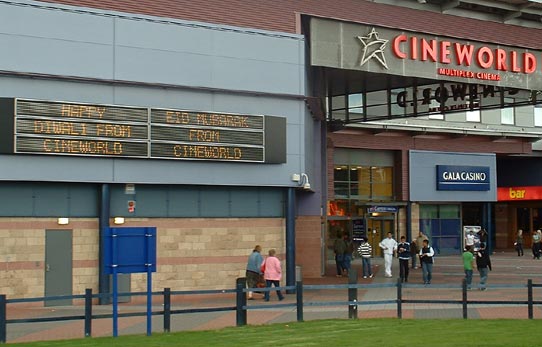 2006 has offered a boost to the marketeers of Bollywood films in the UK -- and provided film and media students with a good example of how film distribution works. The Muslim festival of Eid ul-Fitr celebrates the end of Ramadan, which because it is part of the lunar calendar occurs approx. 11 days earlier each year of the Gregorian calendar. In 2006 Eid was celebrated on 23/24 October in the UK. This coincided with the Hindu festival of Diwali, which also moves in relation to the Gregorian calendar, but always occurs at roughly the same time of year. This year it started on October 21 and lasted for several days.
The coincidence of the two festivals meant that both of the two major UK Asian communities were looking for family celebrations at the same time. The Bollywood distributors held back major releases so that there was nothing playing in Bradford last week, in order to concentrate on the holidays this week when they opened two big films, the romance Jaan-e-maan and the action film Don (a remake of a 1978 Amitabh film with Shahrukh Khan in the lead). An interesting short piece in the Guardian G2 on Monday October 23 by Saima Raza describes how Bradford Asian families now see the Eid festivities as the perfect time to go to the movies.
I went into Bradford yesterday and it was buzzing on an afternoon with changeable weather. Since it's half-term as well, Cineworld was packed and I gave up trying to get a ticket, going to see Zinedine Zidane: A 21st Century Portrait instead. Since the Hollywood offer is pretty dire at the moment (with the exception of The Departed), the two Bollywood films could take up to five screens out of fourteen at various times of the day. It will be interesting to see how the two films fare in the weeks Box Office Top 15.
Tuesday, September 05, 2006
Kabhi Alvida Naa Kehna: New Bollywood?
I love Bollywood, but I’m a real starter when it comes to knowing about the films, so it would be great to hear people’s responses to Kabhi Alvida Naa Kehna. (Director: Karan Johar). I remember Lagaan seemed to promise the first Indian cross-over success, but KANK is far more modern. Not your typical Bollywood product, it's set in New York and deals with divorce and infidelity. The characters drink and there is a definite lack of the trademark Bollywood music and dancing, given the ‘hero’ is an injured football pro. Any musical numbers are modernised and often set in discos.
I’d made a mental note to discuss it with my students who are Bollywood fans, but saw (Screen International 1/09/06) that is has had the biggest box office opening in territories other than India, for a Bollywood film. It has some of the brightest stars of Bollywood, such as Shah Rukh Khan, not for the first time tackling a quite unsympathetic hero. The film is pretty tortuous - there’s loads more dialogue than usual – and some of it pretty dreadful!
I’m not sure how far it represents a true Bollywood film for the global market though – although it seems it might be targeted at younger viewers. It certainly is different from Johar’s 2004 film Veer Zaara (which had three out of the four leads) which was far more traditional, particularly in gender representations.
I’d love to know how it fits in with other, earlier Bollywood or how younger people (i.e. students) have responded to it? Or any other films that people think make ‘westernised’ Bollywood, for the global market? (I’m thinking particularly about A2 Film and Media options re World Cinema, and for teaching institution, generally?)
I’d made a mental note to discuss it with my students who are Bollywood fans, but saw (Screen International 1/09/06) that is has had the biggest box office opening in territories other than India, for a Bollywood film. It has some of the brightest stars of Bollywood, such as Shah Rukh Khan, not for the first time tackling a quite unsympathetic hero. The film is pretty tortuous - there’s loads more dialogue than usual – and some of it pretty dreadful!
I’m not sure how far it represents a true Bollywood film for the global market though – although it seems it might be targeted at younger viewers. It certainly is different from Johar’s 2004 film Veer Zaara (which had three out of the four leads) which was far more traditional, particularly in gender representations.
I’d love to know how it fits in with other, earlier Bollywood or how younger people (i.e. students) have responded to it? Or any other films that people think make ‘westernised’ Bollywood, for the global market? (I’m thinking particularly about A2 Film and Media options re World Cinema, and for teaching institution, generally?)
Subscribe to:
Posts (Atom)

